
The Everest High Pass Trek (commonly known as the Everest Three Passes Trek) stands as the definitive pinnacle of Himalayan high-altitude trekking. Circumnavigating the grand Sagarmatha National Park, this ultimate loop links three mountain passes exceeding 5,300 meters: Kongma La (5,535m), Cho La (5,420m), and Renjo La (5,360m).
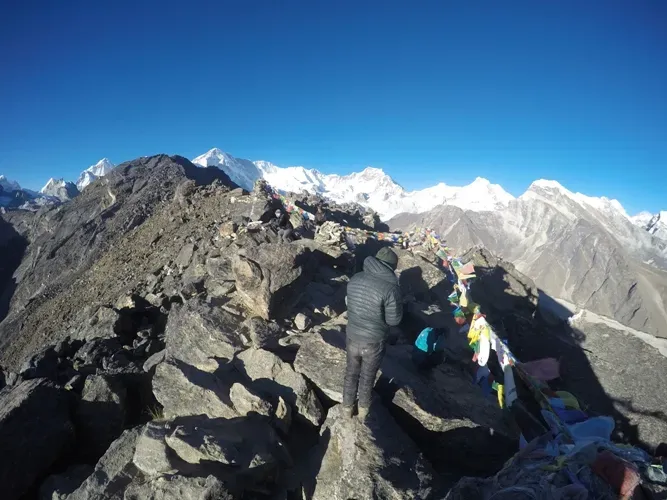
While standard routes to Everest Base Camp (EBC) follow a linear, crowded highway, the High Pass circuit ventures deep into remote side-valleys, turquoise glacial lakes, and solitary Sherpa settlements. It combines classic Himalayan milestones—including Everest Base Camp, Kala Patthar, and the Gokyo Valley—into an exhilarating, non-stop high-altitude journey.
Route Overview & Essential Metrics
|
Parameter |
Specification |
|
Total Distance |
~160 km to 180 km (100–112 miles) |
|
Duration |
18 to 21 Days (including Kathmandu logistics & acclimatization) |
|
Maximum Elevation |
5,555 m / 18,225 ft (Kala Patthar summit) |
|
Trek Difficulty |
Strenuous / Demanding High-Altitude |
|
Accommodations |
Local Teahouses / Alpine Lodges |
|
Permits Required |
Sagarmatha National Park Entry Permit & Khumbu Pasang Lhamu Rural Municipality Permit |
Anatomy of the Three High Passes
[ Cho La Pass ]
(5,420m)
/
(Gokyo Lakes) / (Khumbu Glacier)
/
[ Renjo La Pass ] — — [ Kongma La Pass ]
(5,360m) (5,535m)
/
— [ Namche Bazaar ] ————–/
(3,440m Hub)
1. Kongma La Pass (5,535m / 18,159 ft)
-
Location: Connects the Imja Valley (Chhukung) to the upper Khumbu Valley (Lobuche).
-
Character: Physical testing ground.
-
The Experience: Positioned as the highest and often physically toughest pass on the traditional counter-clockwise loop, Kongma La sits directly below the giant walls of Lhotse and Nuptse. Crossing this pass involves steep ascents over unstable scree and loose rock, ending with a tricky, fatigue-inducing traverse across the debris-covered Khumbu Glacier before reaching Lobuche.
2. Cho La Pass (5,420m / 17,782 ft)
-
Location: Connects the Khumbu corridor (Dzongla) to the Gokyo Lakes region (Thagnak).
-
Character: Technical & glaciated.
-
The Experience: Cho La demands careful footing due to its steep rock scrambles and an active glacier field on its eastern flank. Depending on the season and weather, microspikes or light crampons are essential for safe passage over snow and icy slabs. Surmounting Cho La grants breathtaking views back toward Ama Dablam and down into the valley of Gokyo.
3. Renjo La Pass (5,360m / 17,585 ft)
-
Location: Links the Gokyo Valley to the pristine, less-traveled Bhote Koshi Valley (Lungden).
-
Character: Panoramic reward.
-
The Experience: Widely considered the most visually stunning pass of the circuit, Renjo La offers an unobstructed, 360-degree wall of giant peaks. Looking back to the east, you see the turquoise waters of Gokyo Lake 3 reflecting Mount Everest, Lhotse, Makalu, and Cho Oyu. The descent into the Bhote Koshi valley drops trekkers into quiet Sherpa grazing pastures far off the beaten path.
Classical 19-Day Counter-Clockwise Itinerary
Walking counter-clockwise ensures a gradual elevation gain, allowing your body to adapt before tackling the highest pass (Kongma La).
Day 01: Flight to Lukla (2,840m) | Trek to Phakding (2,610m)
Day 02: Trek Phakding to Namche Bazaar (3,440m)
Day 03: Rest & Acclimatization in Namche Bazaar (Hike to Hotel Everest View – 3,880m)
Day 04: Trek Namche Bazaar to Tengboche (3,860m)
Day 05: Trek Tengboche to Dingboche (4,410m)
Day 06: Acclimatization Day in Dingboche (Hike Nangkartsang Peak – 5,083m)
Day 07: Trek Dingboche to Chhukung (4,730m)
Day 08: Cross KONGMA LA PASS (5,535m) | Descend to Lobuche (4,910m)
Day 09: Trek Lobuche to Gorak Shep (5,164m) | Hike to Everest Base Camp (5,364m)
Day 10: Early Climb to Kala Patthar (5,555m) | Trek to Dzongla (4,710m)
Day 11: Cross CHO LA PASS (5,420m) | Descend to Thagnak (4,700m)
Day 12: Trek Thagnak to Gokyo Village (4,790m) via Ngozumpa Glacier
Day 13: Sunrise Climb up Gokyo Ri (5,357m) | Exploration of 4th/5th Gokyo Lakes
Day 14: Cross RENJO LA PASS (5,360m) | Descend to Lungden (4,368m)
Day 15: Trek Lungden to Thame (3,800m)
Day 16: Trek Thame to Namche Bazaar (3,440m)
Day 17: Trek Namche Bazaar to Lukla (2,840m)
Day 18: Morning Flight Lukla to Kathmandu / Ramechhap
Day 19: Buffer / Contingency Day in Kathmandu
Strategic Weather Windows
Trekking in the High Himalayas is heavily dictated by seasonal monsoons and high-altitude freezes.
Autumn (October – November): The Gold Standard
-
Conditions: Crystal-clear atmospheric clarity, stable blue skies, and dry trails.
-
Considerations: October is the prime window. Temperatures drop below freezing at night past mid-November, but daytime conditions remain ideal for high pass crossings.
Spring (March – May): Wildflowers & Climbers
-
Conditions: Rhododendrons bloom in lower forests, daytime temperatures warm up, and daytime visibility remains strong.
-
Considerations: Snowpack on early March pass crossings can linger. Everest Base Camp is bustling with expedition tents during April and May.
Off-Peak Seasons (Monsoon & Winter)
-
June – August (Monsoon): Heavily discouraged. High risk of rain, landslides at lower altitudes, obscured mountain views, and leeches.
-
December – February (Winter): Requires mountaineering awareness. Extreme sub-zero cold (-20°C to -30°C at night) and heavy snow frequently block the high passes, making unguided crossings dangerous.
Training, Safety & Altitude Management
The High Pass circuit keeps trekkers above 4,500 meters for 9 to 11 days straight. Preparing your body and mind for sustained exertion in thin air is mandatory.
Physical Conditioning
Target a 12-to-16-week pre-trek regimen:
-
Aerobic Endurance: Weighted stair-master sessions, long trail runs, and cycling (3–4 times per week).
-
Strength & Load Carrying: Back squat, lunges, plank variations, and weekly day hikes carrying a 10–12 kg (22–26 lbs) backpack.
Acute Mountain Sickness (AMS) Protocol
High altitude affects everyone regardless of baseline fitness.
-
Rule of Ascent: Do not increase your sleeping altitude by more than 400–500 meters per day above 3,000 meters.
-
Hydration: Drink 4 to 5 liters of water daily. Electrolytes help maintain fluid balance.
-
Medical Readiness: Carry Acetazolamide (Diamox) after consulting a travel physician. If symptoms of moderate-to-severe AMS (persistent throbbing headache, nausea, loss of coordination) develop, descend immediately.
-
Insurance: Ensure your travel insurance policy explicitly covers high-altitude trekking up to 6,000 meters and emergency helicopter evacuation.
Essential Gear Checklist
Clothing System:
– Base layer (2x Merino wool long-sleeve tops + bottoms)
– Mid-layer fleece jacket / Grid fleece
– Synthetic active insulation jacket
– Heavy down parka (-15°C to -20°C rating)
– Waterproof/windproof Gore-Tex shell jacket & pants
– Trekking pants (2x) + thermal underwear
Footwear & Technical Gear:
– Broken-in, waterproof high-top hiking boots
– Light microspikes or trail crampons (crucial for Cho La Pass)
– Sturdy adjustable trekking poles
– Down sleeping bag (Comfort rating -15°C / 0°F)
Electronics & Hydration:
– High-capacity power bank (20,000 mAh+; cold drains batteries fast)
– UV water purifier (SteriPEN) or chemical treatment tablets
– Headlamp with extra batteries (for early 3 AM pass starts)
Final Thoughts: Is the High Pass Trek for You?
The Everest High Pass Trek is not a casual walk through the mountains; it is an endurance challenge that demands physical grit, proper acclimatization, and respect for Himalayan weather. However, for seasoned hikers who want to go beyond the standard base camp trail, this circuit offers the ultimate high-altitude experience—combining quiet mountain routes, technical terrain, and panoramic views of the world’s highest peaks.